San Juan Islands Directory
.Com
History of the San Juan Islands
Historical Geology and Geography, Natural and Cultural
History of the San Juan Islands Washington Map, Museums,
Historical Sites and Places. Local Island History and
Washington Ancestors. Events that changed the course of
history. The bizarre conflicts and confrontations.
History and Lore of the 172
San Juan Islands
(double-click any
word - get its instant definitiion in the dictionary)
San Juan Islands Geology
The land which makes up the San Juan Islands is much older
than the mainland. The San Juan Islands is a chunk of an ancient
continent which attached itself to the mainland millions of
years ago. Overview
of Geologic Forces Worn down by glaciers and
weathering the sedimentary rocks exposed on the San Juan Islands
range from Paleozoic era (540 to 250 million years ago) 320
million years of Paleozoic era saw development of most
invertebrate groups, evolution of fish, reptiles, insects,
vascular plants, and at least two ice ages. Paleozoic
era
 Evolution
San Juan Islands History;
Early Inhabitants
Coast Salish people inhabited the area for more
than 11,000 years. There is very little visible evidence
remaining of their long occupation of the land, much has
disappeared as the result of nature and development.
Archaeologists did find locations in the San Juan Islands that
had nearly 100,000 prehistoric and historic artifacts - most of
them shells, charcoal and fish bone. There where "summer camps"
occupied for about 4,000 years where people fished and harvested
shellfish and "winter village" sites used by native people for
about 2,000 years up to the historic period. Archaeologists know
Paleo-Indian people were in Western Washington. Clovis points
(stone blades used by people around 11,500 years ago) were found
in Puget Sound. Record is hard to find here due to the present
dense forest cover, erosion and sea level fluctuations that
occurred when the glaciers retreated 13,000 years ago. Recent
history; the Lummi Indians were year round inhabitants of San
Juan Island. They lived on the North side of the island before
migrating to Orcas Island and later Gooseberry Point near
Bellingham Washington. Lummi and Coast Salish Villages of the
San Juan Islands and Puget Sound. Map of the known permanent
village sites of the Coast Salish people who lived--and still
live--in the Puget Sound San Juan Islands area of Washington
State
Coast
Salish People of Puget Sound Washington State .... Map,
Pictures, Old Stories and Myths
 Totem Figures
San Juan Islands History;
Explorers and Early Settlers
At one time the northwest country was claimed by four nations
? England, Spain, Russia and United States.
Apostolos Valerianos (called Juan de Fuca) was a Greek sea
captain who sailed the Pacific in the late 1500's for the
Spanish. He claimed to have discovered on one of his trips the
northwest coast of the United States, a "broad inlet of sea" he
found land and waterways in almost every direction of the
compass. Widespread information circulated of the existence of
what became called de Fuca's strait. The first European record
of a landing on the Washington coast was by Spanish Captain Don
Bruno de Heceta in 1775 on board the Santiago, part of a
two-ship flotilla with the Sonora. They claimed all the coastal
lands up to the Russian possessions in the north for Spain. In
1778, British explorer Captain James Cook sighted Cape Flattery,
at the entrance to the Strait of Juan de Fuca, but the straits
would not be explored until 1789 by Captain Charles W. Barkley.
Barkley explored the entrance to a broad strait off the
northwest coast. Barkley supposed he had found Juan de Fuca's
strait and gave it that name. He did not enter far enough to see
the San Juan Islands. The first man to do so was Manuel Quimper,
a Spanish explorer, he saw the islands however he mistook the
islands for a part of the mainland to the north. The San Juan
Islands archipelago was first explored by Europeans in late
1700's. Francisco de Eliza of Spain. As commander of the
expedition, Eliza had the responsibility of charting the region
and the honor of naming what was found. He claimed the
archipelago for Spain and named it the San Juans. The Spanish
explorers left their mark on the land with names like San Juan
and Orcas. However the actual first settlement was founded by
Americans and British. There was border disputes between Canada
and the United States. In 1872 a German arbitrator ( Kaiser
Wilhelm) awarded the San Juan Islands to the USA.
 Spain
Spain  British
  USA
USA  Canada
British and USA Conflict -
San Juan Island Pig War
An American settler and Fraser River gold miner named Lyman
Cutlar settled on San Juan Island and his actions nearly brought
on a war between the Americans and British. This is the jest of
the story; Lyman Cutler had a farm and patch of garden near the
(HBC) Hudson Bay Co. post overlooking Griffin Bay. British
Charles Griffin appointed Justice of the Peace by the Governor
of Vancouver Island and manager of the HBC post had a pig. The
pig broke into Cutlar's garden one too many times. Cutlar shot
the pig. Cutlar had to row 15 miles across the Strait of Juan de
Fuca to the Olympic Peninsula a few times to get the seed for
his crops and lost most of his crops more than once due to
Griffin's porker pigging out on it. Cutlar did admit to killing
the pig, but refused to be brought to trial by the British and
sought protection from the United States. Tensions mounted, both
countries established garrisons, tensions did calm down.
British  Pig War
 USA
USA
English
Camp and American Camp National Historical Parks
San Juan Islands Rock,
Minerals and Fossils
The oldest rocks in the San Juan Islands are Devonian limestone,
argillite, black shale, siltstone, and andesite tuff. The early
Pennsylvanian is represented by rocks containing limestone
lenses and beds. Fossils help identify the age. Volcanic rock
and chert of Jurassic age. Rocks and
Minerals
San Juan Islands Wildlife and
Marine life
Approximately 83 islands in the San Juan Islands archipelago are
designated as National Wildlife Refuges. The San Juan Islands
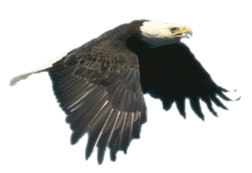
hosts over 250 different species of birds. "Bald Eagle" the San
Juan Islands have the largest breeding population in the
continental United States. Bird watching: You are very
likely to see Bald Eagles, Hawk, Ospreys, Owls, Swans,
Woodpeckers, Geese, Blue Heron, Oystercatcher, Turnstones,
Pelagic Cormorants, Marbled Murrelets, Puffins, Guillemots,
Chickadee, Hummingbird, Shorebirds including Snow Geese and
Trumpeter Swan migration. Marine life: It is notably
stated that the inland waters of Washington is one the richest
marine environment in the world. There are three resident Orca
Whale pods (J, K, & L) they inhabit the waters April
-September. A subspecie of the resident Orcas, called transients
they inhabit the area and are seen year round. These whales are
smaller in size. "Minke Whale" a small baleen whale is seen
Summer - Autumn. Grey Whales and Humpback Whales are known to
pass through the area as well. A common mammal sighted in the
islands is the "Dall Porpoise" The dall porpoise is often
mistaken for an Orca Whale, due to being black & white in
color, they only grow to about six feet. "Harbor Seal" the most
common mammal in the islands spend a lot of time lounging
"hauled-out" on rocks, basking in the sun and that is where they
give birth to their young. The harbor seal is small and are
mostly white and spotted with gray and black. "Steller sea
lions" Male Steller sea lions can weigh over 2000 lbs."River
Otter" brown river otters. Other Creatures: Deer,
Rabbits, Raccoons and Squirrels.
San Juan Islands Wildlife
and Marine Life Pictures
 _____
_____
San Juan Islands Museums,
Historical Societies and Historic Places
San Juan County, Washington
San Juan County encompasses the range of islands north of
Whidbey Island.
Established 1873. Land area, 175 (square miles) Consists of 172
named islands. (100's more at lower tide). The nearest major
population centers are Victoria BC, Vancouver BC and Seattle WA.
The San Juan Islands that have Washington State Ferry Service;
Lopez, Shaw, Orcas and San Juan Island.
Lopez
Island Museum and Historical Society - - - Orcas Island
Museum and Historical Society
San
Juan Island Museum and Historical Society
National Register of
Historic Places

San Juan Islands Map and
Pictures from around the San Juan Islands.
San Juan Islands and Puget Sound Washington Historical Map:
Birds Eye View
Vancouver Island BC Historical Map for orientation to the San
Juan Islands View
Island maps, pictures, aerial photos and information.
Spieden Island - Stuart Island - Henry Island - Jones Island -
James Island - Waldron Island Sucia Island - Matia Island -
Patos Island - Lummi Island - Clark Island - Barnes Island -
Sinclair Island Cypress Island - Cone Islands opening scene of
the movie Free Willy filmed there. And the Washington State
ferry serviced islands; Shaw Island, Lopez Island, Orcas Island
and San Juan Island.
Maps, Pictures, Aerial
Photos and Marine Parks .... San Juan
Islands Washington Information
Current Washington
State Ferry Schedule
San Juan Islands Ferry Schedules
Lopez Island, Shaw Island, Orcas Island, San Juan Island Ferry
Schedule.
View Pictures of San Juan Islands Ferries, Ferry
Route Map, Ferry Terminal Cams, GPS and More!
When you purchase your WSF ticket you are paying for a round
trip ticket. On your way back to Anacortes (eastbound) you can
get off and visit any island for as long as you want. As long as
you are going Eastbound there is no charge to get on and
off the Ferry. San Juan
Islands Ferrry Schedule
Washington Historical
Records Search. Do you have Washington Ancestors?
The Secretary of State has embarked on a project
that will allow people to search for their Washington ancestors
online Ancestor
Search
Chief Seattle's Speech
In 1851 Seattle, chief of the Suquamish and other
Indian tribes around Washington's Puget Sound, in my opinion
delivered one of the most beautiful environmental statements
ever made. The city of Seattle is named for the chief.

Famous Picture of Chief Seattle
My favorite part of Chief Seattle's speech.
You must teach your children that the ground beneath their feet
is the ashes of your grandfathers, so that they will respect the
land, tell your children that the earth is rich with the lives
of our kin, whatever befalls the earth befalls the sons of the
earth, if men spit upon the ground, they spit upon themselves,
The earth does not belong to man; man belongs to the earth.
San Juan Islands Directory
San Juan Islands
Visitor Information and Business Directory w/links.
Find lodging, dining, boating, whale watching, real estate,
transportation,
WA. ferry schedules, attractions and activities in the San
Juan Islands
San Juan Islands Washington information at you finger tips.
Home
www.sanjuanislandsdirectory.com
copyright 2002-- 2013 all rights reserved
 =
=
Maintained by Orcas Island
Studios (360)-376-2472
Orcas Island, WA.
COPYRIGHT 2004 - 2011---ask
for Dave
Disclaimer: THIS PAGE IS A SERVICE
In establishing the hypertext links on this page we do not
represent in any way, expressly or by implication, that we have
received endorsement, sponsorship or support for this Page.The
links provided are to references, for further details and
information sources. Orcas Island Studios makes no claims,
promises or guarantees about the accuracy, completeness, or
adequacy of the contents. Do not rely on maps or any information
presented.CONTENT LIABILITY: READ